
Revisiting the 2024 Game Awards Nominations Two Years Later — Astro Bot and Final Fantasy 7 Rebirth Dominated
Astro Bot and Final Fantasy 7 Rebirth dominated the 2024 Game Awards nominations with seven each, while Elden Ring's expansion sparked rule debates.
Here we are in 2026, and I still find myself drifting back to the 2024 Game Awards nominations like a moth circling a particularly bright porch light. Two years ago, the full list dropped in a flurry of social media alerts, and frankly, my group chats haven't recovered. The way those six Game of the Year contenders locked into place was like watching a high-stakes chess endgame — every piece weighted with history and hype. Astro Bot, Balatro, Black Myth: Wukong, Elden Ring: Shadow of the Erdtree, Final Fantasy 7 Rebirth, and Metaphor: ReFantazio all stood shoulder to shoulder, a lineup that still sparks debates whenever I’m queuing for multiplayer matches.
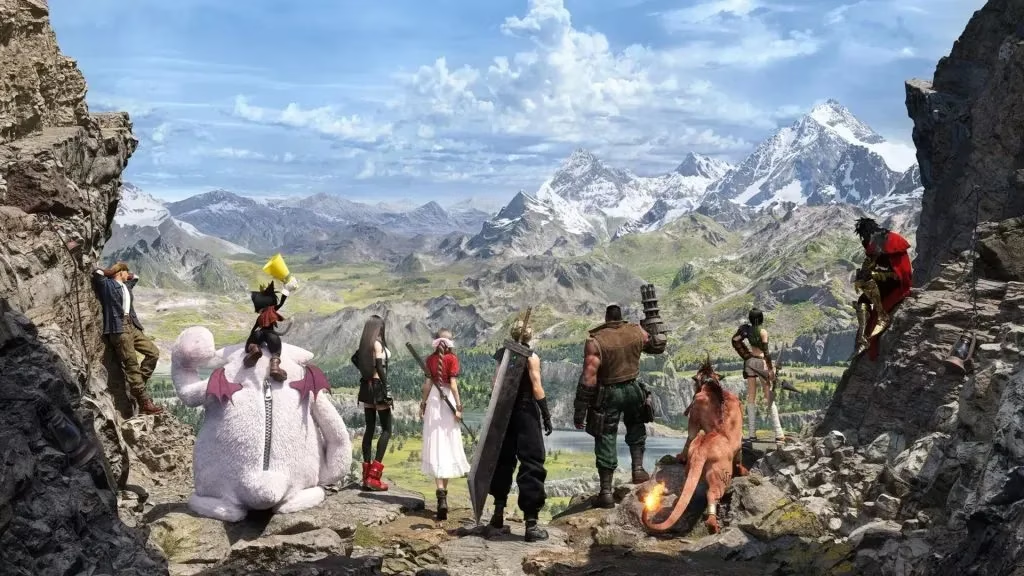
Let’s pause right there on that Game of the Year bracket. I vividly remember the collective gasp when Elden Ring’s expansion slipped into the mix. Geoff Keighley’s clarification just before the reveal — that expansions, remakes, and remasters were now eligible — felt like someone subtly rewriting the rules of a board game mid-session. Yet in hindsight, Shadow of the Erdtree earned its seat at the table; it was an expansion that wore the ambition of a full-blown sequel like an elaborate cloak. The real heartbreak in 2024, though, was seeing Helldivers 2, Silent Hill 2, and Like a Dragon: Infinite Wealth cast as brilliant outsiders, gazing through the window of a party they were not invited to. Even now, mumbling “Helldivers 2 didn’t make the cut” makes my co-op squad adopt the somber tone of a eulogy.
A Tally That Rewrote Publisher Scorecards
Looking at the nomination scoreboard two years later feels like rereading a drama-filled sports match summary. Astro Bot and Final Fantasy 7 Rebirth tied with seven nominations each, practically strapping rocket boosters to their acceptance speeches before the ceremony even happened. Metaphor: ReFantazio followed with six, while Balatro and Silent Hill 2 pocketed five apiece. Black Myth: Wukong, Elden Ring: Shadow of the Erdtree, Call of Duty: Black Ops 6, Helldivers 2, and Senua’s Saga: Hellblade 2 each walked away with four nods, a spread that made every fan forum feel like a casino betting floor.
Publisher dynamics were equally fascinating. PlayStation strutted to the front with 16 nominations, a glittering figure that mirrored its 2024 console momentum. Square Enix and Xbox both snagged 12 nods, while Sega danced close behind with 11. This wasn’t just a list; it was a corporate chessboard that told me exactly where the industry’s creative weight had settled that year.
Categories That Became Instant Conversation Starters
Beyond the main stage, some categories hummed with stories that aged well. Best Narrative had Final Fantasy 7 Rebirth and Metaphor: ReFantazio squaring off against the psychological horror of Silent Hill 2, a clash that felt like a three-way tug-of-war for my late-night gaming hours. Best Art Direction gave us the painterly elegance of Neva alongside the mythic brushstrokes of Black Myth: Wukong — a reminder that artistic vision can be as transportive as any VR headset. The audio categories were a feast too; the Best Score and Music field stacked Astro Bot’s infectious beats against Final Fantasy 7 Rebirth’s operatic sweep, while Best Audio Design showcased Senua’s Saga: Hellblade 2’s binaural sorcery.
And can we talk about performances? Briana White’s turn as Aerith in Final Fantasy 7 Rebirth was an emotional lightning rod that still resonates. When her name appeared in the Best Performance category alongside Luke Roberts’ devastating Silent Hill 2 portrayal and Melina Juergens’ raw Senua, it crystallized how deeply acting had rooted itself into the medium by 2024. Watching those nominees felt like witnessing the point where games fully matured as narrative art, no longer the awkward cousin of film but the charismatic sibling that steals the spotlight.
The Underdogs and the Wave of the Future
Balatro, the poker-inspired rogue-like, became my favorite dark horse story — imagine a tiny indie paper boat navigating a storm of AAA flamethrowers and somehow staying afloat. It appeared in Best Indie, Best Debut Indie, and even Best Mobile Game, a trifecta that made me root for it like an underdog sports team. Its inclusion in Game of the Year was the kind of beautiful anomaly that reminds us why these awards matter: a game built around shuffling cards could stand shoulder to shoulder with vast fantasy epics.
The “Most Anticipated Game” category, meanwhile, was a time capsule of 2024’s future that has already delivered or is still simmering. Death Stranding 2: On the Beach, Ghost of Yotei, Grand Theft Auto 6, Metroid Prime 4: Beyond, and Monster Hunter Wilds — reading them now in 2026 is surreal. Some have launched and recalibrated the industry; others remain tantalizing mirages I continually check for updates. That five-title list was essentially a prophecy scrawled on the wall of The Game Awards.
Lingering Echoes in 2026
The December 12 ceremony may feel like ancient history, but the ripples haven’t settled. The eligibility shift for expansions permanently altered how we talk about post-launch content. Astro Bot’s dominance heralded a renaissance for inventive 3D platformers that we’re still enjoying. And Final Fantasy 7 Rebirth’s narrative grip cemented the trilogy’s middle chapter as a landmark. Whenever I replay any of these titles, I’m transported back to that nomination morning, when the gaming world’s collective bargaining over winners felt as alive as any in-game boss fight.