
How Game Science Finally Stitched the Missing Xbox Robe for Black Myth: Wukong
Black Myth: Wukong Xbox release faces memory bottleneck; Game Science strives for parity and optimization amid fan anticipation.
It was a cold December evening in 2024 when Feng Ji, the founder and CEO of Game Science, sat down to pen a heartfelt message on Weibo. The Steam Awards had just concluded, and Black Myth: Wukong had swept multiple categories, including the coveted Game of the Year trophy. The action RPG’s journey from a stunning debut trailer to a global phenomenon felt complete—almost. Beneath the celebration, a quiet yearning lingered among a dedicated subset of fans. They watched the accolades pile up from the sidelines, clutching their Xbox controllers, still waiting.
Feng Ji did not ignore them. In his post, he acknowledged their patience with a bittersweet metaphor: “Your combat capabilities are so terrifying, and the only thing missing is the Xbox robe… It seems a bit inappropriate, but the 10 GB shared memory, without several years of optimization experience, it is really difficult to use it.” The words, loosely translated, pierced through the holiday cheer and laid bare a technical dragon that had been breathing fire at the studio’s doorstep since the game’s launch on PC and PS5. The Xbox Series S, with its 10 GB of shared RAM between CPU and GPU, had become the unyielding wall between the Monkey King and an entire platform.
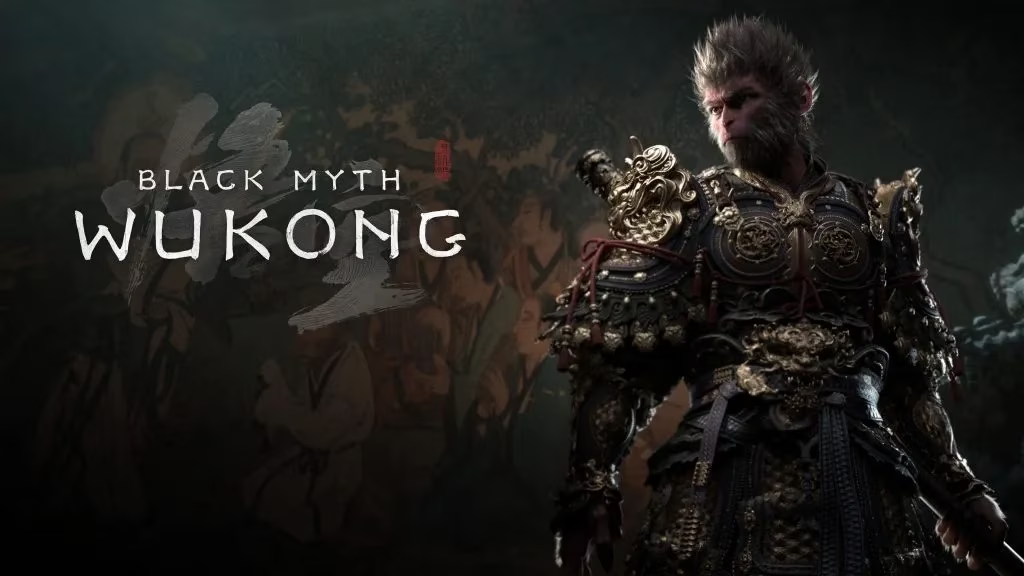
Microsoft’s parity clause demanded that every game released on Xbox Series X must also run on Series S with full feature support. For developers, this meant wrestling the more modest hardware into submission—a challenge that had already delayed titles like Baldur’s Gate 3, which famously launched without local co-op on the smaller console. But for Black Myth: Wukong, a game that pushed Unreal Engine 5 to its limits with sprawling vistas, dense particle effects, and relentless boss encounters, the 10 GB bottleneck felt like trying to thread a silk robe through the eye of a needle. Every megabyte counted, and the memory overhead simply wasn’t there.
Back in October 2024, hope had briefly sparked when the ESRB rated the game for Xbox Series X/S. Fans combed through the rating board’s listing, convinced an announcement was imminent. But weeks turned into months, and the silence from Game Science grew louder. Feng Ji’s December confession confirmed what many had feared: the Xbox version existed in a limbo of optimization hell. Engineers were pouring over memory allocation profiles, streaming textures, and asset culling techniques, yet the target remained elusive. The year 2025 arrived with no release date, only fleeting mentions in quarterly reports and a growing legend of the “missing robe.”
Then, in early 2026, the winds shifted. A cryptic teaser appeared on Game Science’s social channels—a silhouette of Wukong against a green-tinted sky, the Xbox logo glowing faintly on his headband. The gaming world erupted. At a dedicated showcase in March, Feng Ji took the stage to deliver the news personally. With visible emotion, he described a two-year odyssey where a core team of engineers practically rewrote the memory management subsystems from scratch. “We learned to treat every kilobyte like a precious scroll,” he said, half-joking. The solution combined aggressive dynamic resolution scaling, intelligent texture streaming that responded to combat intensity, and a bespoke compression pipeline that squeezed assets into packets so tight that even the 10 GB pool felt generous.
The result was not just a port, but a masterclass in optimization. The game ran at a stable frame rate on Series S, preserving all combat fluidity and visual splendor that had earned it a torrent of perfect scores. On Series X, the update added ray-traced reflections, higher foliage density, and a 60 fps performance mode that rivaled high-end PCs. On the day of release, digital storefronts crashed under the weight of Xbox pre-orders. Social media flooded with clips of players finally donning the “Xbox robe,” a phrase now immortalized by Feng Ji’s old Weibo post.
Feng Ji returned to Weibo one more time in the summer of 2026, posting a simple image of the complete award shelf—Steam trophies, PlayStation accolades, and now, a small Xbox badge pinned to a collector’s edition robe. “It took years, but we stitched every thread,” he wrote. For the developers at Game Science, the journey was never just about shipping a product. It was about honoring a promise whispered to a community that had refused to hang up their controllers. And in the end, the Monkey King didn’t just break his chains on PC and PlayStation; he shattered the memory ceiling with a grin, proving that even shared RAM can’t cage a legend when determination runs deep.