
Black Myth: Wukong Benchmark Still Humbles Hardware in 2026, But Combat Stays Elusive
Black Myth: Wukong's benchmark tool reveals RTX 4070's 82fps on Very High, 75fps on Cinematic, and 58fps with ray tracing.
Even two years after its thunderous debut, Black Myth: Wukong remains a rite of passage for gaming PCs. The free benchmarking tool that arrived just before the game’s launch in 2024 continues to serve as a stern digital examiner, allowing enthusiasts to probe their rigs against one of the most visually dense action titles ever crafted. While the full game now sits firmly in the canon of modern classics, the standalone test still sees regular downloads from players wanting a quick, repeatable stress check. Its results remain telling—partly because of what they reveal, and partly because of what they strategically omit.
The tool drops the user into a lush, rain-slicked forest sequence that unfolds like a painterly scroll dragged through a high‑frame‑rate projector. There are no attacks, no dodges, no split‑second parries—only scenery. This makes the benchmark something of a museum gallery for lighting, particle, and texture artistry, rather than a battle rehearsal. In 2026, a mid‑range graphics card such as the Nvidia GeForce RTX 4070 still encounters the sequence with a mixture of grace and humility. It is a silicon actor performing a soliloquy in an empty theatre: poised, technically impressive, yet never truly tested by the chaos for which the main game is infamous.
When the benchmark is run at 2,560 x 1,440 on the Very High preset, the RTX 4070 delivers an average of 82 frames per second, with a low of 73 fps and a ceiling of 96 fps. The data stream resembles a placid heart monitor, spiking only once at the very beginning before settling into a cadence that mirrors steady breathing. Nvidia DLSS is locked to Quality mode—presented here as a percentage slider rather than a toggle—and frame generation is engaged, acting as a digital forge that hammers extra frames into being from the raw metal of rendered data.
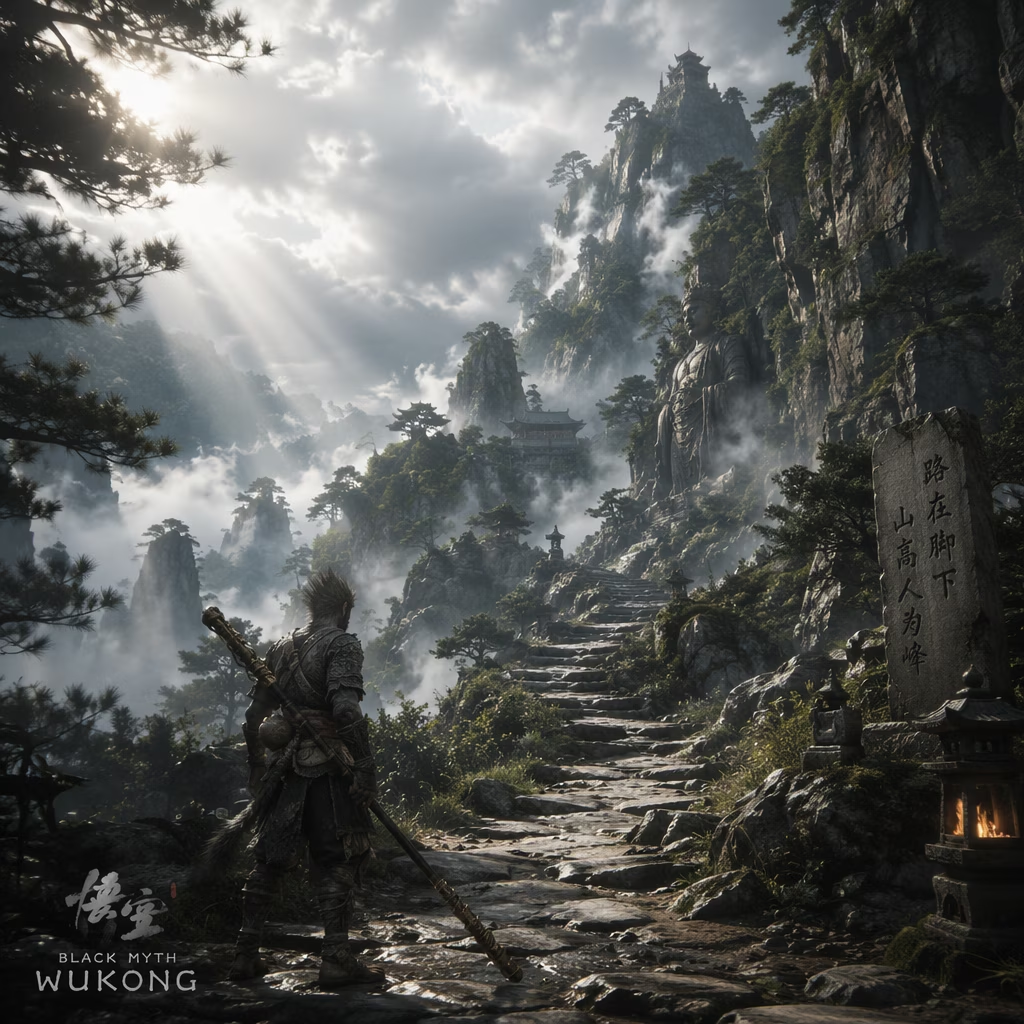
Switching to the Cinematic preset adds a gossamer layer of extra fidelity. Shadow resolution tightens, anti‑aliasing spreads its net wider, and the draw distance yawns open. The performance cost is a small but perceptible tithe: the average slips to 75 fps, while the minimum holds at a remarkably clean 63 fps. There are no sudden drops, no stuttering cracks in the visual eggshell. For many, this is the sweet spot where the game’s legendary atmosphere tangibly deepens without demanding a hardware exorcism.
When ray tracing is then cranked to its maximum on the Cinematic preset, the benchmark transforms into something more demanding. Light behaves with the meticulousness of a master calligrapher, tracing every leaf and puddle with refractive precision. The RTX 4070 concedes ground gracefully, returning an average of 58 fps, with dips to 48 fps and peaks at 72 fps. This is where the GPU’s thermal and compute headroom begin to feel like a reservoir slowly draining—still functional, yet no longer overflowing. The result remains smooth enough for a controller‑driven game, but it underscores how raytracing in Black Myth: Wukong is a luxury that demands sober respect.
A parallel test conducted at a native 4K resolution underlines the engine’s appetite for power. With an RTX 4070 Super, frame generation disabled, and DLSS set to DLAA (where the AI simply applies anti‑aliasing without upscaling), the benchmark churned out a 25 fps average without ray tracing. Flicking on frame generation immediately pulled that figure up to 40 fps. The gap is a testament to the sorcery of modern upscaling techniques—a digital alembic transmuting strained silicon into playable responsiveness. It also makes clear that native‑resolution purists will need flagship‑class hardware to approach anything close to 60 fps in this title.
Yet the benchmark’s glaring absence is the dance of combat—the flurry of Red Tides, the evasive wind‑steps, the neon arc of a charged heavy strike. None of this appears in the tool. Observers have long noted that the promotional footage showing the protagonist weaving through armies of yaoguai is conspicuously missing from the test. This omission acts like a connoisseur displaying only the wine label without letting anyone taste the vintage. It invites skepticism about whether the smooth curves seen in the benchmark could ever survive the percussive demands of a boss encounter, where particle storms, physics collisions, and AI routines conspire to drain frame budgets with the ruthlessness of a hungry river.
In 2026, the community consensus has largely filled this gap. Crowd‑sourced data confirms that combat sequences can impose a 15‑20% heavier load than the benchmarked forest walk, especially during multi‑enemy encounters with volumetric fog and destructible objects. Prudent players still use the official tool as a preliminary health check, then add a mental buffer for the battleground. The benchmark remains a reliable stress test for thermal management and general GPU stability, even if it is an incomplete predictor of the full experience.
For those who acquired the game through the generous Nvidia GPU bundles that ran during the launch window, the benchmark likely served as a first handshake with the engine. MSI’s limited‑edition Black Myth: Wukong graphics card, meanwhile, has become a collector’s ghost—spotted in forums, rarely in the wild. Its existence underscores how deeply the game has imprinted itself on hardware culture.
The benchmarking tool thus endures not as a perfect oracle, but as a beautifully incomplete prologue. It still offers a serene gallery walk through technical prowess, even as it sidesteps the true furnace of the game’s identity. As long as players chase the perfect balance of eye‑candy and frame rate in 2026, this free download will remain a trusted, if teasing, companion.